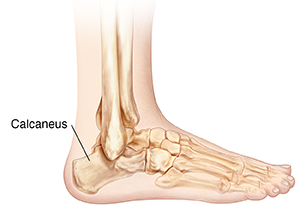
The calcaneus is the heel bone. This bone may become fractured during a high-energy injury. This includes such things as a fall from a height, a twisting injury to the ankle, or a car accident. The heel may break in several places. The fracture may cause your foot to become misshapen. It may be difficult or impossible to walk on. The injury is often very painful.
How to say it
kal-KAY-nee-us
Why calcaneus fracture repair is done
A fracture of the heel bone may result in multiple pieces of broken bone. The broken pieces may be displaced. This means they no longer line up correctly with each other. You may need surgery to repair a heel fracture so you can use your foot again. During surgery, the surgeon moves the pieces of bone back into place. The surgeon then puts in metal devices (internal fixation) to hold the bone pieces in place while they heal.
How calcaneus fracture repair is done
The surgery is most often done on an outpatient basis. That means that you go home the same day. During the surgery:
-
You are given medicine to help you relax and to prevent pain. You will likely be given general anesthesia. This puts you into a state like deep sleep during the procedure. You may also have a nerve block. This numbs the foot during the surgery and for a time afterward.
-
With open surgery: The surgeon makes an incision over your heel. They move the bones back into place. The surgeon then places pins, wires, screws, or metal plates to hold the bone pieces together. They close the skin incision with stitches. The fixation stays in place and is not generally removed.
-
With closed reduction (percutaneous fixation): The surgeon moves the bone pieces back into place under the skin through small incisions (cuts). They insert special screws or plates to hold the bone pieces together. The fixation stays in place and is not generally removed.
-
Your foot is put into a splint or cast. You will likely be told to not put weight on the foot for several weeks after the surgery.
Depending on the severity of the fracture, you may still have problems with walking after the bone has healed. Orthotics or other support may help.
Risks of calcaneus fracture repair
Risks include:
-
Bleeding.
-
Infection.
-
Irritation to nearby nerves or tendons.
-
The fracture does not heal.
-
The skin does not heal.
-
Lasting pain and swelling.
-
Arthritis.
-
More surgery is needed in the future.
Author: Michels, Karen
Online Medical Reviewer: Rahul Banerjee MD
Online Medical Reviewer: Stacey Wojcik MBA BSN RN
Date Last Reviewed: 05/01/2025
© 2000-2026 The StayWell Company, LLC. All rights reserved. This information is not intended as a substitute for professional medical care. Always follow your healthcare professional's instructions.