The thumb bone closest to your wrist is called the first metacarpal. This bone meets the wrist at a joint called the carpometacarpal (CMC) joint. Bennett fracture is a break of the lower part of the first metacarpal bone. The fracture is often displaced. This means that the first metacarpal no longer sits correctly in the joint.
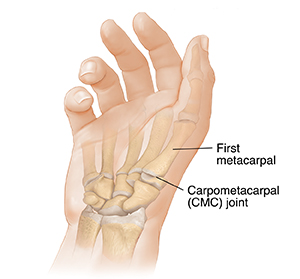
What causes Bennett fracture?
The most common cause of this fracture is a direct blow to the bent thumb. This may happen during activities such as:
-
Boxing or martial arts.
-
Fistfights.
-
Contact sports such as football or rugby.
Symptoms of Bennett fracture
Symptoms of this type of fracture include:
-
Severe pain and weakness of the thumb.
-
Swelling of the base of the thumb and back of the hand.
-
Bruising.
-
Misalignment of the thumb.
-
Trouble moving the thumb.
-
Numbness or coldness in the thumb.
Treatment for Bennett fracture
Treatment depends on whether the broken ends of the bone are displaced. This means that they have moved away from each other.
Treatment often includes reduction of the fracture. This involves moving the broken pieces of bone back into alignment with each other. It also involves moving the bone back into the CMC joint.
-
Closed reduction is done without surgery. You are given medicine to prevent pain. The surgeon then moves the bones back into place from outside the skin. In many cases, the doctor puts pins through tiny incisions to hold the reduction in place.
-
Open reduction is done using surgery. You are given medicine to prevent pain and make you sleep. The surgeon makes incisions in the skin. They then move the bones back into place. Removable pins or screws are used to hold the bones in place while they heal.
After the reduction:
-
A cast or splint is put on your hand to keep the thumb from moving while the bones heal.
-
You will be given medicines to help control pain and swelling.
-
You will be told to ice and elevate your hand to help control pain and swelling.
-
After healing, try stretching and strengthening exercises to help regain full use of the thumb and hand.
Possible complications of Bennett fracture
Complications include:
-
Bones not healing or healing in a bad position.
-
Continued pain in the thumb or hand.
-
Continued weakness in the thumb or hand.
-
Stiffness of the thumb joint.
-
Arthritis.
When to contact your doctor
Contact your doctor right away if:
-
Pain gets worse.
-
Symptoms don’t get better, or they get worse.
-
The thumb becomes cold or numb.
-
There is redness, warmth, or drainage.
-
You have a fever of 100.4°F (38°C) or higher, or as directed by your doctor.
-
You have chills.
-
The thumbnail becomes blue or gray.
-
You have new symptoms.
Author: Michels, Karen
Online Medical Reviewer: Rahul Banerjee MD
Online Medical Reviewer: Stacey Wojcik MBA BSN RN
Date Last Reviewed: 05/01/2025
© 2000-2026 The StayWell Company, LLC. All rights reserved. This information is not intended as a substitute for professional medical care. Always follow your healthcare professional's instructions.

