Dismiss Modal

Management

Increasing Your Knee’s Range of Motion

Choose a preferred language

Swelling, tight or weak muscles, or scar tissue may make it hard to move your knee. Work with your physical therapist to increase your knee’s range of motion. You may have some of the treatments below to help.
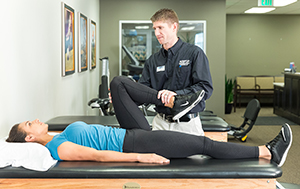
Physical therapist working with woman on leg stretches.

  • Thermal ultrasound. Sound waves are used to warm up knee tissues. This improves blood flow and can speed up tissue healing.

  • Moving your kneecap (patella mobilization). This is done by you or your physical therapist. It prevents the buildup of scar tissue and improves range of motion.

  • Bracing or taping. These are often used to correct a problem with patellar tracking. They also let your muscles work more. And they give you a sense of stability when you have weakness or pain.

  • Passive range-of-motion exercises. These gently bend and straighten your knee joint. Your leg is moved by your physical therapist or a machine.

  • Assisted range-of-motion exercises. These also move your knee. You use your own strength. Your physical therapist or a machine will help you.

  • Active range-of-motion exercises. These are done by bending and straightening your knees under your own power.


© 2000-2025 The StayWell Company, LLC. All rights reserved. This information is not intended as a substitute for professional medical care. Always follow your healthcare professional's instructions.
Related Articles
Read article
Orthopedics
Walker Boot

Aircast Walker boot is a short boot that supports and protects the foot and ankle while allowing you to walk.

Read article
Orthopedics
Using Crutches: Up and Down Steps

When climbing up and down steps using crutches, remember this rule: Up with the good (unaffected leg) and down with the bad (affected leg). Read on for helpful tips and illustrations.

Read article
Orthopedics
Leg Muscle Stretches: Knee Flexion

The following flexibility exercise may be suggested by your therapist. Repeat as many times as instructed. Stop the exercise if it causes pain, and discuss it with your physical therapist or healthcare provider:

Read article
Orthopedics
Self-Care for Strains and Sprains

Most minor strains and sprains can be treated with self-care. But if you have torn tissue or damaged blood vessels, nerves, or bones, be sure to call your healthcare provider.