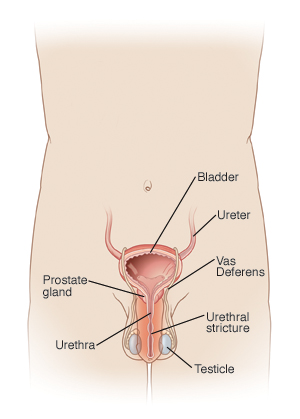
The urethra is the tube that carries urine out of the body. In a woman, the urethra's opening is in front of the vagina. In a man, it is at the tip of the penis. A narrowing or blockage of the urethra is called a urethral stricture. This is more common in men than in women.
Causes
A blockage of the urethra is often caused by scar tissue. This may be due to surgery, sexually transmitted infections, or long-term catheter use. The cause can also be unknown.
Symptoms
The symptoms of urethral stricture include:
-
Slow urine flow or a urine stream that is split or a spray
-
Urine leakage or dribbling (incontinence)
-
Can't empty the bladder fully
-
Pain when urinating
-
Pain in the pelvis or lower belly
-
Frequent urge to urinate
-
Blood in the urine
-
Urinary tract infection
Treatment
If your stricture is severe, a tube (catheter) may be put into your urethra to drain your bladder. This should ease pain for a short time. Without treatment, strictures almost always come back. You will need to follow up with a healthcare provider who specializes in diseases of the urinary tract (urologist) to find the best treatment for your condition.
Home care
-
If you were given antibiotics, take them until they are used up, or until your healthcare provider tells you to stop. Finish the antibiotics even if you feel better. This is to make sure your infection has cleared.
-
If a catheter was inserted, follow the instructions provided for catheter care.
Follow-up care
Follow up with your healthcare provider, or as advised.
When to get medical advice
Call your healthcare provider right away if any of these occur:
-
Fever of 100.4ºF (38ºC) or higher, or as directed by your provider
-
Bladder pain or fullness
-
Belly pain or swelling
-
Nausea or vomiting
-
Back pain
-
Weakness, dizziness, or fainting
Featured in


