The hip is one of the largest weight-bearing joints in the body. It’s also a common place for a fracture after a fall—especially in older people. Hip fractures are even more likely in people with osteoporosis, a disease that leads to weakened bones.
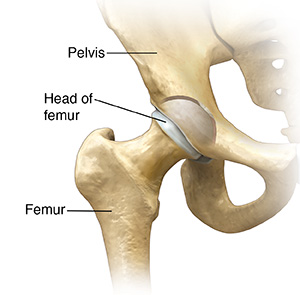
A healthy hip
The hip is a ball-and-socket joint where the thighbone (femur) joins the pelvis. When the hip is healthy, you can walk, turn, and move without pain. The head or ball of the femur fits into a socket in the pelvis. The ball and socket are each covered with smooth cartilage. This allows the ball to glide easily in the socket. Blood vessels supply oxygen and nutrients to keep the hip joint healthy.
A fractured hip
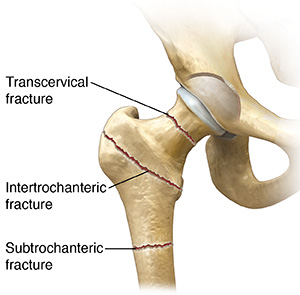
The hip can fracture in many places. Most often, the fracture occurs in the upper part of the femur. In rare cases, you can also have more than one type of fracture at a time:
-
Transcervical fracture. A break across the neck of the femur, just under the ball. This type of fracture can interrupt blood flow to the joint.
-
Intertrochanteric fracture. A break down through the top of the femur.
-
Subtrochanteric fracture. A break across the upper shaft of the femur.
Online Medical Reviewer: Rahul Banerjee MD
Online Medical Reviewer: Raymond Turley Jr PA-C
Online Medical Reviewer: Rita Sather RN
Date Last Reviewed: 04/01/2024
© 2000-2026 The StayWell Company, LLC. All rights reserved. This information is not intended as a substitute for professional medical care. Always follow your healthcare professional's instructions.

