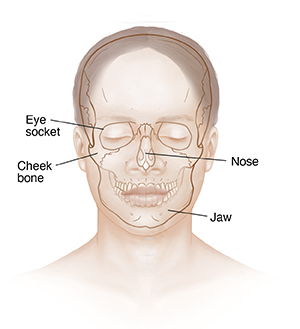
A facial fracture means you have 1 or more broken bones in your face. These may be in your jaw, nose, cheeks, or the sockets around your eyes. Car accidents are the most common cause of facial fractures. Fights, falls, and sports injuries can also injure facial bones.
When to go to the emergency room (ER)
A broken bone in your face is cause for concern. The airway may become clogged with bone fragments, blood clots, or swollen tissue. Go to the ER or call
-
Pain and swelling in your face
-
Trouble swallowing or breathing
-
An upper and lower jaw that don't meet correctly, or pain when you move your jaw
-
A displaced jaw or nose
-
Loose teeth
-
An open wound where you can see the bone
-
Blood or clear fluid from your nose
-
Blurred vision, double vision, or problems moving your eyeball
What to expect in the ER
You will likely be given medicine for pain. A healthcare provider will ask about your injury and examine your head and face. X-rays or other imaging tests may be done. Treatment of facial fractures happens in 2 stages:
-
Reduction. The broken bones are put back into place. This is often done after the swelling goes down. But severe fractures may be repaired right away.
-
Fixation. The broken bones are held together so they heal correctly. A fractured jaw is likely to be wired shut for a time, stabilized with reconstruction plates, or both. A broken nose is treated with a splint or soft packing. Surgery may be done to repair and secure broken bones around your eyes.