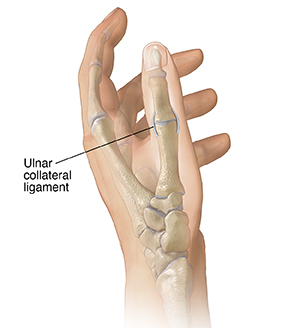
Skier’s thumb (sometimes called gamekeeper’s thumb) is an injury to the ulnar collateral ligament. This ligament is located at the base of your thumb on the side near the index (pointer) finger. It helps keep your thumb stable when grasping or pinching objects. With skier’s thumb, the ligament is stretched or torn (sprained). This can cause pain and can limit movement and use of the thumb. You may need surgery to repair or reconstruct the ligament and restore function.
Why surgical repair of skier’s thumb is done
If your ligament is severely stretched or torn, or if nearby tissues and bone are also injured, your injury may not heal correctly on its own. You may need surgery. This can help the ligament heal and restore movement to and full use of your thumb.
How surgical repair of skier’s thumb is done
The surgery is most often done on an outpatient basis. That means that you go home the same day. During the surgery:
-
You are given medicine to help you relax and to prevent pain. You may be drowsy or completely asleep during the procedure. You may also have a nerve block. This numbs your arm during the surgery and for a time afterward.
-
The surgeon makes a cut (incision) at the base of your thumb.
-
The surgeon reattaches the ligament to the bone using stitches (sutures) and often small anchors. They will also repair any injury to the tissues around it. If a bone fracture is present, the surgeon may repair it with wires or screws.
-
When the procedure is done, the surgeon closes the skin incision with sutures.
-
Your doctor will put a splint on your hand to hold your thumb still while the repair heals.
Risks of surgical repair for skier’s thumb
-
Bleeding
-
Infection
-
Damage to nearby nerves leading to numbness and tingling
-
Stiffness or reduced range of motion of the thumb
-
Arthritis
Author: Michels, Karen
Online Medical Reviewer: Kenny Turley PA-C
Online Medical Reviewer: L Renee Watson MSN RN
Online Medical Reviewer: Thomas N Joseph MD
Date Last Reviewed: 05/01/2025
© 2000-2026 The StayWell Company, LLC. All rights reserved. This information is not intended as a substitute for professional medical care. Always follow your healthcare professional's instructions.