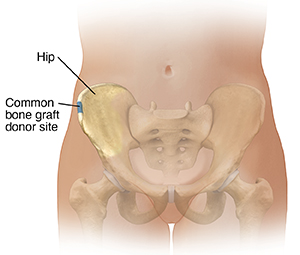
Bone grafting is surgery to repair and rebuild bones that are damaged or diseased. A graft is tissue removed from one place in the body and put in another place. A bone graft may be used to repair bones almost anywhere in your body. Your surgeon may take (harvest) bone from one of your hips, legs, or ribs. The most common place for harvesting bone for a graft is the hip. In some cases, surgeons use bone tissue donated from someone who has died (a cadaver). In other cases, artificial materials may also be used.
How bone repair works
Most of your skeleton is made up of bone matrix. Bone matrix is the hard material that gives bones their strength. The matrix has bone cells. The bone cells make and support the matrix. The cells help repair and heal your bones when needed.
When you break (fracture) a bone, your bone cells may be able to repair it. But with some fractures, a large amount of bone is lost. This can happen if the bone breaks in many pieces or if it goes through the skin. Your bone cells may not be able to repair it. This is when a bone graft may be needed.
During bone grafting, your surgeon inserts a new piece of bone where a bone needs to heal or join. The cells inside the new bone join with the old bone.
Why bone grafting is done
You may need bone grafting if you have:
-
A new fracture that is unlikely to heal without a graft.
-
An old fracture that didn’t heal well.
-
Bone cancer.
-
Lower blood supply to a bone (osteonecrosis).
-
Surgery on the spine.
-
Other surgery that needs help with bone growth and healing.
How bone grafting is done
Your graft will be done by an orthopedic surgeon. The surgeon will make a cut (incision) through the skin and muscle around the bone that needs the graft. If bone from another part of your body will be used for the graft, the surgeon will make another incision to remove a small part of the other bone. This piece of bone will be used for the graft. If using cadaver bone, your surgeon will prepare the piece of bone. The graft bone will be placed next to the bone that needs to grow together. The graft may be kept in place with special screws, plates, or other methods.
Risks of bone grafting
All procedures have risks. Your risks vary based on your age and general health. For example, if you are a smoker or if you have low bone density, you may have a higher risk for certain problems. People with diabetes may also have a higher risk for problems. Talk with your health care provider about which risks apply most to you. The risks of bone grafting include:
-
Infection.
-
Bleeding.
-
Blood clots.
-
Nerve damage.
-
Problems from anesthesia during surgery.
-
Poor bone healing, even with a graft.
If the surgeon uses bone from another part of your body for the graft, you will have two surgical wounds. With two wounds, you will have an increased chance for infection and bleeding.