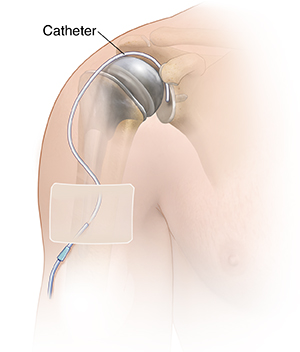
Infection may occur after a joint replacement. To treat it, antibiotics may be sent directly into the joint through a small, thin tube called a catheter. The catheter is placed during a surgical procedure. It remains in place for several weeks.
Why antibiotic treatment through a catheter for joint infection is done
Infection after a joint replacement may damage the new joint. This infection often needs several weeks of antibiotic treatment. To help antibiotics work best and most quickly, they are given directly into the joint. This is done through a soft tube called a catheter. The catheter is put into the joint and fixed in place. It remains in the joint until it's no longer needed.
How antibiotic treatment through a catheter for joint infection is done
-
The surgeon makes a small cut (incision) over the joint.
-
The surgeon puts the catheter through the incision into the joint. The catheter is often sewn into place.
-
The surgeon sews the skin closed around the catheter.
-
Fluids containing antibiotic medicines are sent through the catheter into the joint.
-
The catheter stays in place until the infection has been treated and the catheter is no longer needed. The surgeon then removes it during a second procedure.
Risks of antibiotic treatment through a catheter for joint infection
-
Infection
-
Bleeding
-
Blood clots
-
Catheter comes out of the joint and needs to be replaced
Author: Michels, Karen
© 2000-2026 The StayWell Company, LLC. All rights reserved. This information is not intended as a substitute for professional medical care. Always follow your healthcare professional's instructions.