Dismiss Modal

Treatment

Treating Trigger Finger

Choose a preferred language

Trigger finger occurs when the tissue inside your finger or thumb becomes inflamed. Mild cases can be treated without surgery. If the problem is severe, surgery may be needed. Your healthcare provider will talk with you about your choices.


Nonsurgical treatment

For mild symptoms, your healthcare provider may have you rest the finger or thumb. You may also be told to take anti-inflammatory medicines. These include ibuprofen or aspirin. You may be given an injection of medicine in the base of the finger or thumb. This typically is a steroid, such as cortisone. Cortisone is a powerful anti-inflammatory.


Surgery

If nonsurgical treatments don’t ease your symptoms, you may need surgery. A tendon is a cord-like fiber that attaches muscle to bone and allows joints to bend. The tendon is surrounded by a protective cover called a sheath. During surgery, the sheath in your finger or thumb is opened to enlarge the space and release the swollen tendon. This allows the finger or thumb to bend and straighten normally. Surgery takes about 20 minutes. It can often be done using a local anesthetic. You may also be sedated. You will likely be able to go home the same day. Your hand will be wrapped in a soft bandage. You may need to wear a plaster splint for a short time to keep the finger or thumb still as it heals. The stitches will be removed in about  2 weeks. Your healthcare provider will talk with you about the risks and benefits of surgery.
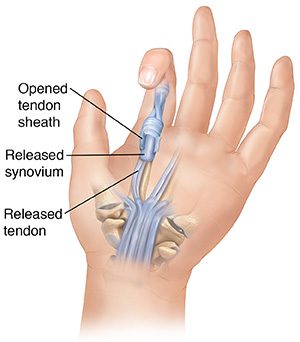
Palm view of hand showing cut tendon sheath repair of trigger finger.

© 2000-2025 The StayWell Company, LLC. All rights reserved. This information is not intended as a substitute for professional medical care. Always follow your healthcare professional's instructions.
Related Articles
Read article
Orthopedics
Hip Arthroscopy: Repairing Synovitis and Arthritis

Arthroscopy can be used to repair synovitis and arthritis.

Read article
Orthopedics
Kneecap Surgery: Removing Damaged Cartilage

Surgery may be used when pain severely limits your activities. Or it may be done when a rehab program or other nonsurgical treatments just are not helping enough. Some procedures may be done using arthroscopy. This method uses tiny incisions and special instruments to look and work inside the knee joint. Other procedures need open surgery.

Read article
Orthopedics
Before Arthroscopy

Here's what to know before you have arthroscopy.

Read article
Orthopedics
Foot Surgery: Curled Fifth Toe

A curled fifth toe is most often inherited. When the fifth toe curls inward, it moves under the next toe. Then the nail of the curled toe starts to face outward. As a result, you may bear weight on the side of your toe instead of the bottom. This can cause corns and painful nails. There are many nonsurgical treatments available. But if these are not effective, surgery is a choice.