Trigger finger occurs when the tissue inside your finger or thumb becomes inflamed. Mild cases can be treated without surgery. If the problem is severe, surgery may be needed. Your healthcare provider will talk with you about your choices.
Nonsurgical treatment
For most cases of trigger finger, your healthcare provider may have you rest the finger or thumb. You may also be told to take anti-inflammatory medicines. These include ibuprofen or aspirin. You may be given an injection of medicine in the base of the finger or thumb. This typically is a steroid, such as cortisone. Cortisone is a powerful anti-inflammatory and is very effective in curing most cases of trigger finger.
Surgery
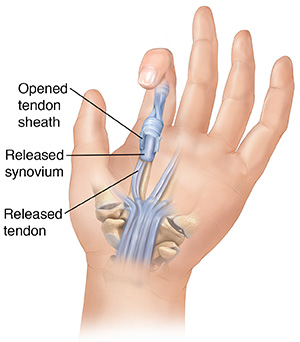
If nonsurgical treatments don’t ease your symptoms, you may need surgery. A tendon is a cord-like fiber that attaches muscle to bone and allows joints to bend. The tendon is surrounded by a protective cover called a sheath. During surgery, the sheath in your finger or thumb is opened to enlarge the space at the location of a ligament in your hand called the A1pulley and release the swollen tendon. This allows the finger or thumb to bend and straighten normally. Surgery takes about
Online Medical Reviewer: L Renee Watson MSN RN
Online Medical Reviewer: Raymond Turley Jr PA-C
Online Medical Reviewer: Thomas N Joseph MD
Date Last Reviewed: 09/01/2025
© 2000-2026 The StayWell Company, LLC. All rights reserved. This information is not intended as a substitute for professional medical care. Always follow your healthcare professional's instructions.