The goal of your treatment for de Quervain's tenosynovitis (say "duh-kair-VANZ ten-oh-sin-uh-VY-tus") is to ease your pain and allow you to use your thumb again. Treatment will depend on how bad the pain is.
Nonsurgical treatment
Just taking a break from the activities that caused your pain may be enough. Your doctor may also have you take nonsteroidal, anti-inflammatory drugs, such as ibuprofen. You may also wear a splint for a few weeks to rest the thumb and wrist. To ease swelling, your doctor may inject an anti-inflammatory medicine, such as cortisone around the tendons.
You may have more pain at first. But in a few days your thumb should feel better. Physical therapy or therapy with an occupational therapist or certified hand therapist is often helpful as well.
Surgery
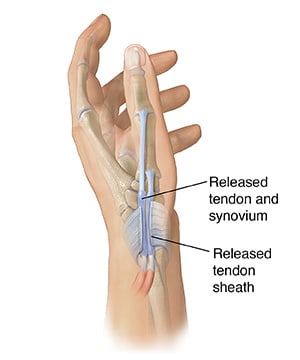
If other kinds of treatment don't ease your pain, or if the pain is bad, you may need surgery. The sheath that surrounds the tendons is released so the tendons can move more easily. This helps reduce the inflammation. It also allows you to straighten your thumb without pain.
Surgery is done with local or regional anesthetic on an outpatient basis, so you can go home the same day. You will likely have a splint or dressing on your wrist for a few days while the tissue heals. You may need physical therapy to help make the muscles strong. Your doctor will talk with you about the risks and possible problems of having surgery.
Online Medical Reviewer: Joseph, Thomas N., MD
Online Medical Reviewer: Sather, Rita, RN
Date Last Reviewed: 09/01/2025
© 2000-2026 The StayWell Company, LLC. All rights reserved. This information is not intended as a substitute for professional medical care. Always follow your healthcare professional's instructions.