For many people, nonsurgical treatments are enough to ease shoulder impingement symptoms. But if these and other treatments haven’t worked, surgery may be an option. Surgery can help free up the joint space, allowing pain-free motion. Talk with your healthcare provider to see if surgery is right for you.
Surgery for shoulder impingement
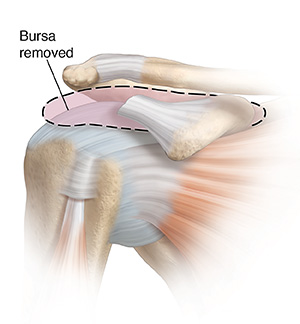
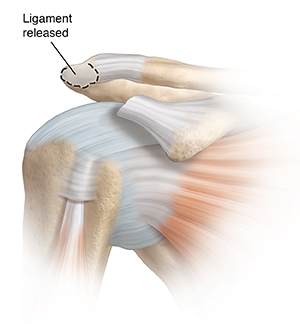
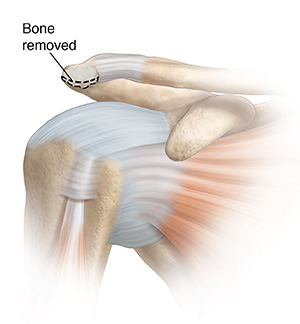
The type of surgery you have depends on your shoulder problem. Surgery can remove the bursa if it is swollen. If the coracoacromial ligament is tight, it may be released. If the acromion is hooked or has bone spurs, a part of it may be taken out. Before surgery, you’ll be given medicine to keep you free from pain. There are 2 different types of surgery. These are:
-
Arthroscopy. Small cuts (incisions) are made in the shoulder. Next, a small, lighted tool (arthroscope) is inserted. A tiny camera is attached on one end of the arthroscope. The camera sends images to a video screen. This lets the surgeon see inside the shoulder.
-
Open surgery. Incisions are made in the shoulder so the surgeon can work inside.
Risks and possible complications of surgery
Your healthcare provider will talk with you about the possible risks and complications of the procedure. These may include:
-
Infection
-
Damage to nerves or blood vessels
-
Loss of flexibility
-
Symptoms that don't completely go away
Featured in
Online Medical Reviewer: L Renee Watson MSN RN
Online Medical Reviewer: Raymond Turley Jr PA-C
Online Medical Reviewer: Thomas N Joseph MD
Date Last Reviewed: 04/01/2024
© 2000-2026 The StayWell Company, LLC. All rights reserved. This information is not intended as a substitute for professional medical care. Always follow your healthcare professional's instructions.