Dismiss Modal

Treatment

Cirugía de la articulación del hombro: Reparación de Bankart

Choose a preferred language

Para reparar una lesión de Bankart (desgarro del labrum) puede realizarse una cirugía en la articulación del hombro. Para esta operación puede usarse una cirugía artroscópica (a través de incisiones muy pequeñas) o una cirugía abierta convencional. El médico elegirá el método más adecuado para su caso.


Preparativos para la operación

  • Mencione a su médico los medicamentos (con o sin receta), hierbas o suplementos que usted toma, incluyendo antiinflamatorios como la aspirina. Averigüe si debe dejar de tomar alguno de ellos antes de la operación.

  • No coma ni beba nada a partir de la medianoche anterior a la operación. Usted debe tener el estómago vacío cuando le pongan la anestesia.

  • Traiga consigo al hospital todas las radiografías, formularios o exploraciones que su médico necesite.

  • Consiga a un familiar o amigo adulto que lo conduzca a su casa.


Durante la operación

Durante la operación, su cirujano examinará detenidamente el labrum y el ligamento glenohumeral y buscará si usted tiene lesiones en otras partes de la articulación del hombro. Podrían hacerle una o más reparaciones:

  • El labrum y el ligamento glenohumeral se vuelven a fijar a la cavidad glenoidea mediante anclajes quirúrgicos o suturas.

  • Podría repararse cualquier otra lesión en el hombro; también podría repararse o tensarse la cápsula (capa de fibras resistentes que rodea a la cavidad glenoidea y el húmero).
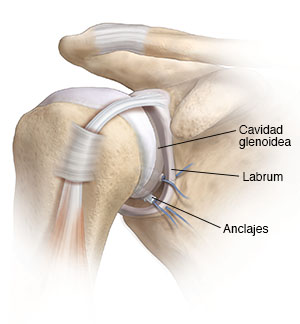
    Vista frontal de la articulación del hombro donde pueden verse desgarro en la parte inferior de labrum. Se están colocando anclaje para reparar el desgarro.


Riesgos y complicaciones posibles de la cirugía del hombro

  • Infección

  • Daños a los nervios o vasos sanguíneos

  • Desplazamiento o rotura de los anclajes quirúrgicos

  • Pérdida de flexibilidad

Featured in

© 2000-2025 The StayWell Company, LLC. Todos los derechos reservados. Esta información no pretende sustituir la atención médica profesional. Sólo su médico puede diagnosticar y tratar un problema de salud.
Related Articles
Read article
Orthopedics
Understanding Leg Amputation: Surgery for a Medical Condition

This surgery removes part or all your leg. It is done because tissue in the leg is diseased and can't be healed. Or it may be needed to prevent the disease from spreading farther into your body. The goal of the surgery is to restore your ability to function. This is because removing the diseased part of your leg can improve your total health.

Read article
Orthopedics
Foot Surgery: Bunions

A bunion is a bony bump. When the distance between the first and second metatarsal bones of the foot is greater than normal, the big toe may turn toward the other toes. A mild bunion may then form causing foot pain and swelling. Bunions are most often found near the joint at the base of the big toe. Bunions tend to run in families. They may cause pain, swelling, and skin irritation.

Read article
Orthopedics
Preparing for Back Surgery

Plan ahead for both your surgery and recovery. Be sure to follow any instructions you are given. And talk to your doctor if you have questions about surgery or how the procedure will be done.

Read article
Orthopedics
Foot Surgery: Degenerative Joint Disease

Degenerative joint disease (arthritis) often happens in the joint of a big toe. This bone growth may cause pain and stiffness in the joint. Left untreated, arthritis can break down the cartilage and destroy the joint. Your treatment choices depend on how damaged your joint is. There are many nonsurgical treatments, but if these are not helpful, surgery may be considered.