You will be told how to get ready for your arthroscopic surgery and when to arrive. Arthroscopy uses a thin tube with a light and camera on the end to look into your joint area. Other thin tubes are inserted through small incisions to guide surgical tools. Just before surgery, a doctor will talk to you about the anesthesia that will be used to keep you free of pain during surgery. Be sure to tell your surgeon about any medicines you take. This includes over-the-counter medicines, vitamins, and supplements. You may be asked by several people to confirm which shoulder is being operated on. This is for your safety. Arthroscopy can be used to both diagnose and treat your shoulder problem during the same surgery. Below are common problems and how they are treated during arthroscopy.
Impingement
-
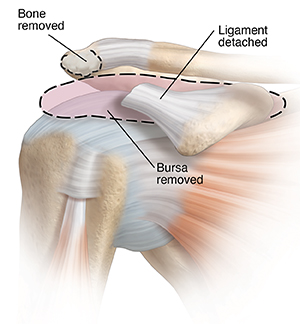
Repeated overhead movements can inflame your rotator cuff and bursa. A bone spur may also form. This causes pain and problems with some arm movements. Impingement is also called bursitis or tendinitis.
-
During surgery, an inflamed bursa may be removed. Bone may be trimmed. And the ligament may be detached. These steps make more room. This eases pressure and lets the arm move more freely.
Torn rotator cuff
-
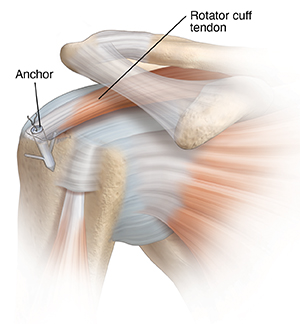
The rotator cuff can tear due to a sudden injury or from overuse. This can cause pain, weakness, and loss of normal shoulder movement.
-
During surgery, torn rotator cuff tendons may be trimmed. The tendons are then reattached to the humerus. This is done with stitches, anchors, or surgical tacks.
Stretched capsule
-
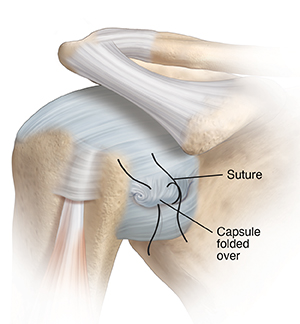
A stretched capsule will often stay loose. A loose capsule can’t hold the joint firmly in place. The bones of the joint may feel like they move too much, and the shoulder can dislocate.
-
During arthroscopy, a stretched capsule is folded over itself and stitched in place. This is done from inside the capsule. This tightens the capsule, helping make the shoulder joint more stable.
Torn labrum
-
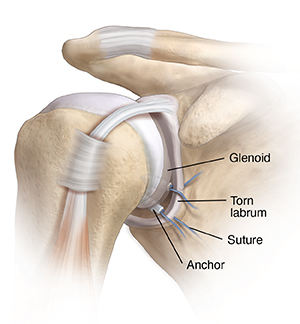
The shoulder is a ball and socket joint. The labrum normally supports and cushions the shoulder joint. In a torn labrum, the socket that the ball (the upper end of your arm) fits into isn't very deep. The shallow socket raises the chance for instability.
-
The labrum may tear off the rim of the glenoid. This can cause the joint to catch or feel like it’s slipping out of place. The shoulder may even dislocate.
-
A torn labrum is fixed by reattaching it to the glenoid. This is often done with special anchors put into the glenoid bone. Stitches attached to the anchors are tied to hold the labrum in place. The joint is then more stable.
Arthritis and loose bodies
-
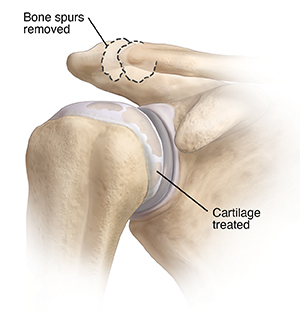
Arthritis is damage to joint cartilage with age and use. Injury or disease can also cause it. Wear and tear may also lead to loose bodies (pieces of bone or cartilage) or bone spurs in a joint.
-
During surgery, bone spurs are removed. Rough parts of the joint are smoothed. Any loose body is removed from the joint. Bone may also be scraped or shaved to help new cartilage growth.


