Dismiss Modal

Recovery

After Knee Replacement: At-Home Exercise Program

Choose a preferred language

Apply the skills you learned in the hospital or rehab center to your exercise program at home. Use a walker, cane, or crutches to help you move safely. By sticking with your exercise program, you’ll walk more easily and return to an active life sooner. Contact your healthcare provider or physical therapist if you have pain while exercising.


Maintaining your exercise program

Make exercise part of your daily routine. Lack of exercise can cause joint stiffness and decreased range of motion.  But with continued exercise, you may even gain more strength and range of motion than you had before surgery. Keep meeting with your physical therapist as directed. They may add riding a stationary bike or other new exercises to your program.

Below is a list of exercises your physical therapist may suggest.


Quadriceps sets

Lying on your back, tighten your thigh muscles. Try to straighten your knee. Hold for 5 to 10 seconds. Gradually build up your time.
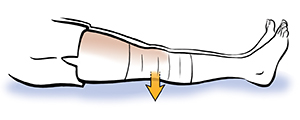
Leg from knee down showing quadriceps sets. Bandage on knee.


Straight leg raises

Tighten your thigh and straighten your knee as with the quadriceps set above. Lift your leg several inches (above your buttocks) off the bed and hold for 5 to 10 seconds. Gradually increase your time and number of repetitions.
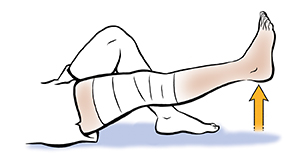
Leg from knee down showing straight leg raise. Bandage on knee.


Sitting knee exercises

Start with 10 repetitions. Build up to 25 repetitions per session. Do 2 sessions each day.

  • Sit in a chair with both feet flat on the floor.

  • Slowly straighten your operated or affected leg as much as you can. Hold for 5 seconds.

  • Slowly bend your leg under the chair, bringing it back as far as you can. Hold for 10 to 20 seconds. Return your leg to the starting point.
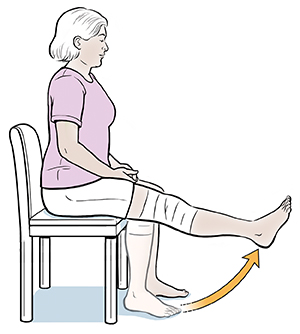

Woman sitting in chair doing sitting knee exercises. Bandage on knee.

© 2000-2025 The StayWell Company, LLC. All rights reserved. This information is not intended as a substitute for professional medical care. Always follow your healthcare professional's instructions.
Related Articles
Read article
Orthopedics
Discharge Instructions for Ankle Arthroscopy

Instructions to help take care of yourself after ankle arthroscopy.

Read article
Orthopedics
Using Log-Roll to Get Out of Bed (Hip Care)

Here are images showing how to safely get out of bed after a hip replacement.

Read article
Orthopedics
Discharge Instructions for Foot Surgery

Arrange to have an adult drive you home after surgery. If you had general anesthesia, it may take a day or more to fully recover. So, for at least the next 24 hours: Do not drive or use machinery or power tools; do not drink alcohol; and do not make any major decisions.

Read article
Orthopedics
Discharge Instructions: Using Crutches (Weight-Bearing)

Your healthcare provider has prescribed crutches for you. A healthy leg can support your body weight, but when you have an injured leg or foot, you need to keep weight off it. Once you are told that you can put some weight on your leg, use a "weight-bearing" method of walking as the leg heals.

