Dismiss Modal

Recovery

After Hip Replacement: Using Your Walker

Choose a preferred language

After hip replacement, you’ll likely use a walker to get around while you recover. There are a few types of walkers:

  • The standard nonrolling walker

  • The 2-wheeled (front) rolling walker

  • The 4-wheeled rolling walker

Your physical therapist or occupational therapist will teach you how to use a walker safely and help you choose the best one for you. Later, you may change from a walker to crutches or a cane.


Using a walker

  • Move the walker a few inches in front of you.

  • Lean on the walker so it supports you. Step into the center with your operated leg. Then step forward with your good leg. Repeat.

  • As you get more comfortable, you’ll be able to move the walker as you step.
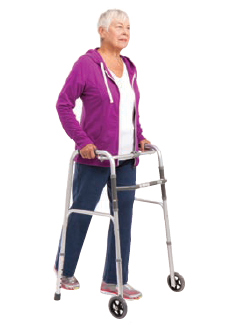
Woman walking with walker.


Walking up a curb

  • Move your feet and walker as close to the curb as possible.

  • Put your weight on both legs, and then lift the walker onto the curb.

  • Step on the curb with your good leg. Using the walker to support your weight, bring up your operated leg.


Walking down a curb

  • Move your feet and walker as close to the curb as possible.

  • Lower the walker onto the ground, keeping its back legs against the curb.

  • Using the walker to support your weight, lower your operated leg. Then step down with your good leg.  

  • Never climb stairs or use an escalator with your walker.
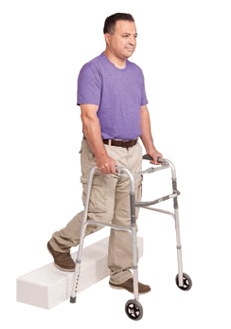
Man going down step with walker.

© 2000-2025 The StayWell Company, LLC. All rights reserved. This information is not intended as a substitute for professional medical care. Always follow your healthcare professional's instructions.
Related Articles
Read article
Orthopedics
Using Log-Roll to Get Out of Bed (Hip Care)

Here are images showing how to safely get out of bed after a hip replacement.

Read article
Orthopedics
Discharge Instructions for Foot Surgery

Arrange to have an adult drive you home after surgery. If you had general anesthesia, it may take a day or more to fully recover. So, for at least the next 24 hours: Do not drive or use machinery or power tools; do not drink alcohol; and do not make any major decisions.

Read article
Orthopedics
Discharge Instructions: Using Crutches (Weight-Bearing)

Your healthcare provider has prescribed crutches for you. A healthy leg can support your body weight, but when you have an injured leg or foot, you need to keep weight off it. Once you are told that you can put some weight on your leg, use a "weight-bearing" method of walking as the leg heals.

Read article
Orthopedics
Crush Injury of the Foot, No Fracture

A crush injury to your foot causes local pain, swelling, and sometimes bruising. There are no broken bones. Learn how to care for your injury at home.