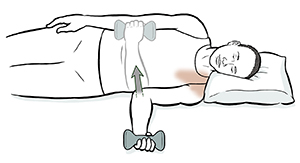
This shows the exercise for your right shoulder. Switch sides for your left shoulder.
-
Put a hand weight on the floor. Your healthcare provider will tell you what size hand weight to use. Usually start with about
1- to 2-pound weights. -
Lie on the floor on your side. Keep your upper arm extended on your side. Support your head and neck with a pillow or small folded towel to keep your neck and spine straight.
-
With your hand closest to the floor, hold the hand weight and let your arm rest on the floor at a right angle. This is your starting position.
-
Slowly raise the hand weight toward your chest, keeping your elbow bent at a right angle the entire time.
-
Slowly lower the hand weight back to the starting position on the floor. Keep your elbow bent at a right angle.
-
Repeat this exercise
8 to 10 times for2 sets, or as instructed. As you get stronger, repeat the exercise5 times for3 sets. As the exercise becomes easier, add weight,1 pound at a time up to5 pounds, and start again with2 sets of8 to 10 repetitions.
Tip
Keep your body still while you raise the weight. Don't roll back.
Author: Wheeler, Brooke
Online Medical Reviewer: Raymond Turley Jr PA-C
Online Medical Reviewer: Stacey Wojcik MBA BSN RN
Online Medical Reviewer: Thomas N Joseph MD
Date Last Reviewed: 12/01/2022
© 2000-2026 The StayWell Company, LLC. All rights reserved. This information is not intended as a substitute for professional medical care. Always follow your healthcare professional's instructions.