A bone density study helps diagnose brittle bones (osteoporosis). Scans of your lower back, hip, or forearm are taken to measure the amount of calcium (density) in your bones. Calcium is the mineral that makes up your bones.
What to tell your technologist
Tell the technologist if you:
-
Are pregnant or think you could be pregnant.
-
Have any metal in the part of your body being imaged, such as a hip replacement.
-
Have had a recent nuclear medicine scan, CT scan with oral contrast, or an X-ray test with oral contrast such as a barium enema, barium swallow, or upper GI.
-
Have a severely curved spine.
-
Have had spinal surgery.
-
Have a history of spinal or hip fractures.
-
Can’t lie on your back.
Before your test
-
Wear clothing without metal closures, such as zippers or metal buttons.
-
Bring a list of medicines that you take.
During your test
-
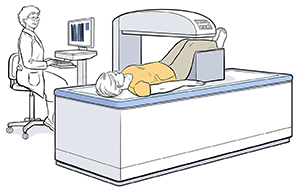
You will lie on a table or sit.
-
Your lower legs may be raised on a platform.
-
A scanner arm moves back and forth over the part of your body being scanned.
-
Stay still and don't talk during the scan.
-
Follow instructions. This can help prevent the need for a second exam.
After your test
-
You may need to wait for a short time while the images are reviewed.
-
Your doctor will discuss the test results with you during a follow-up visit or over the phone.
Your next appointment is: