Dismiss Modal

Definition

How Your Knee Works

Choose a preferred language

A healthy knee bends easily and rotates slightly. The joint absorbs stress and moves smoothly. This allows you to walk, squat, and turn without pain.


A healthy knee

The knee is a hinge joint, formed where the thighbone (femur) and the shinbone (tibia) meet. It's the largest joint in the body. The joint is covered with smooth tissue and powered by large muscles. When all the parts listed below are healthy, a knee should move easily:

  • Cartilage is a layer of smooth tissue. It covers the ends of the thighbone and shinbone. It also lines the back side of the kneecap. Healthy cartilage absorbs stress and allows the knee to bend easily.

  • Muscles power the knee and leg for movement.

  • Tendons attach the muscles to the bones.

  • Ligaments are bands of tissue that connect bones and brace the joint.

  • Bones that make up your knee joint include your thighbone (femur), shinbone (tibia), and kneecap (patella).

  • Menisci are 2 wedge-shaped pieces of cartilage that absorb shock between the thighbone and shinbone.
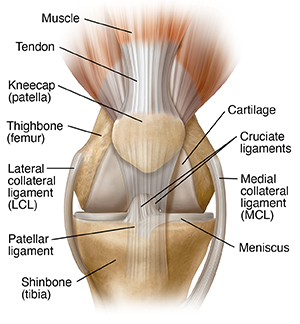

Front view of knee joint.

© 2000-2025 The StayWell Company, LLC. All rights reserved. This information is not intended as a substitute for professional medical care. Always follow your healthcare professional's instructions.
Related Articles
Read article
Orthopedics
Anatomy of a Normal Spine

Learn about the spine with these helpful detailed illustrations.

Read article
Orthopedics
Common Types of Fractures

Bones can break anywhere in the body. Casts are often used for fractures in the hands, arms, legs, or feet. There are many types of fractures. But all fractures heal the same way: New bone grows to connect the broken pieces. A cast holds broken bones in place while they heal.

Read article
Orthopedics
Parts of a Foot

Your foot is made up of soft tissue and bones that work together to form a healthy, functioning, and pain-free foot.

Read article
Orthopedics
What Are Mallet, Hammer, and Claw Toes?

Mallet, hammer, and claw toes are among the most common foot problems. They are often caused by wearing shoes that are too short or heels that are too high.