The hip joint is one of the body’s largest weight-bearing joints. It’s a ball-and-socket joint. This helps the hip remain stable even during twisting and extreme ranges of motion. A healthy hip joint allows you to walk, squat, and turn without pain.
A healthy hip
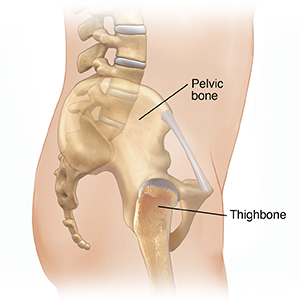
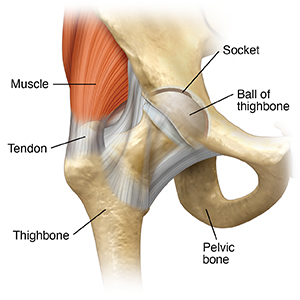
The hip joint is formed where the rounded head of the thighbone (femur) joins the pelvic bone. The joint is covered with tissue and powered by large muscles. When all the parts listed below are healthy, a hip should move easily.
-
Cartilage is a layer of smooth tissue. It covers the ball of the thighbone and lines the socket of the pelvic bone. Healthy cartilage absorbs stress and allows the ball to glide easily in the socket.
-
Muscles power the hip and leg for movement.
-
Tendons attach the muscles to the bones.
Online Medical Reviewer: Joseph, Thomas N., MD
Online Medical Reviewer: Walton-Ziegler, Olivia, MS, PA-C
Date Last Reviewed: 04/01/2024
© 2000-2026 The StayWell Company, LLC. All rights reserved. This information is not intended as a substitute for professional medical care. Always follow your healthcare professional's instructions.