Risks of surgery
-
Infection
-
Bleeding
-
Risks of anesthesia
-
Damage to nerves, muscles, or nearby pelvic structures
-
Blood clots
-
Prolapse of the pelvic organ or organs happening again
-
Pain with sex
The surgical procedure
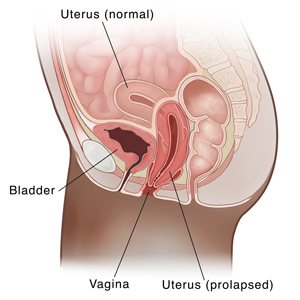
To fix the prolapse, the uterus is often removed. This is called a hysterectomy. Then, the vagina is lifted and supported so it stays in place. This type of surgery can be done through the vagina or abdomen. Stitches are used to attach the vagina to strong tissue in the pelvis. Sometimes a synthetic material or biologic material is used. It reinforces the repair. This supports the top part of the vagina. Other procedures may be done. They will keep the vagina from slipping again. If the uterus is not removed, then the uterus is lifted and supported so it stays in place. There have been some safety concerns with some mesh products. Ask your surgeon if they will be using mesh during your surgery and what the risks may be.
Your incisions
During surgery, the surgeon reaches your pelvic organs through the vagina or the abdomen. If the pelvic organs are reached through the vagina, an incision is made in the wall of the vagina. If the pelvic organs are reached through the abdomen, several small incisions are made in the abdomen to insert tiny laparoscopic tools. Or one larger incision is made in the abdomen. The belly incision can be up and down (vertical) or across (transverse).
Featured in


