Dismiss Modal

Treatment

How Reproductive Laparoscopy Is Done

Choose a preferred language

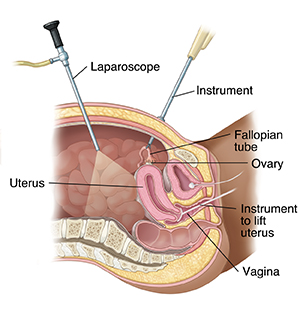
Laparoscopy is a surgical procedure. It lets the surgeon see your reproductive organs up close. After you are given anesthesia, small cuts (incisions) are made in your belly (abdomen). A laparoscope is put into one of the small incisions. A laparoscope is a long, thin tube with a camera on the end. It sends pictures to a video screen. The surgeon can see inside the body. Surgical tools are put through the other incisions to complete the procedure.
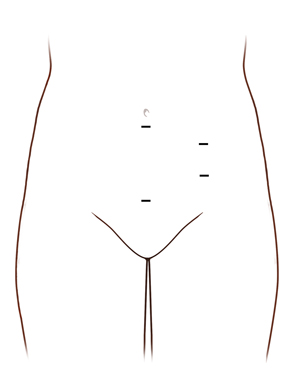
Front view of female abdomen showing possible incision sites for pelvic laparoscopic surgery.

Cross section of female pelvis from the side showing laparoscopy.


A closer look

Your surgeon needs to see clearly during surgery. To do this, your abdomen is inflated with a harmless gas. A device may be put into the vagina to lift the uterus. This helps your surgeon see your organs better through the scope.


Risks and possible complications of surgery

These may include:

  • Infection.

  • Bleeding.

  • Damage to blood vessels, nerves, muscles, uterus, ovaries, fallopian tubes, bowel, bladder, or ureters.

  • Risks of anesthesia.

  • Blood clots.

  • Hernia at the incision site.

  • Need for a larger incision.

Featured in

© 2000-2025 The StayWell Company, LLC. All rights reserved. This information is not intended as a substitute for professional medical care. Always follow your healthcare professional's instructions.
Related Articles
Read article
OB/GYN
Stress Urinary Incontinence: Having Retropubic Suspension Surgery

Retropubic suspension is a type of surgery to treat stress urinary incontinence. Read on for helpful details about the surgery and what to expect.

Read article
OB/GYN
Hysteroscopy

Hysteroscopy is a procedure that allows your health care provider to see inside your uterus. Diagnostic hysteroscopy can help find the causes of problems in the uterus.

Read article
OB/GYN
Myomectomy

Myomectomy is a surgical procedure to remove uterine fibroids. This procedure may preserve your uterus and your ability to have children.

Read article
OB/GYN
Hysterosalpingogram (HSG)

HSG is an X-ray test used to view your uterus and fallopian tubes. It's most often used to help diagnose why you are not able to get pregnant.