A typical pregnancy lasts, on average, 280 days, or 40 weeks—starting with the first day of the last normal menstrual period as day 1. An estimated due date can be calculated by following steps 1 through 3:
- First, determine the first day of your last menstrual period.
- Next, count back 3 calendar months from that date.
- Lastly, add 1 year and 7 days to that date.
For example: Your last menstrual period began on September 9, 2023. Counting back 3 calendar months would be June 9, 2023. Adding 1 year and 7 days would bring you to June 16, 2024, as your estimated due date.
This three-step method is referred to as Naegele's Rule and is based on a normal 28-day menstrual cycle. Therefore, dates may have to be adjusted for longer or shorter menstrual cycles.
You may also estimate your delivery date by using steps 1 and 2 below and the chart:
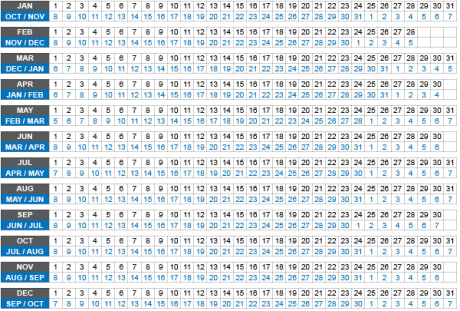
- First, locate the first day of your last menstrual period (in black text).
- Next, note the date directly below. This is your estimated date of delivery (in blue text).
Featured in
Online Medical Reviewer: Donna Freeborn PhD CNM FNP
Online Medical Reviewer: Heather M Trevino BSN RNC
Online Medical Reviewer: Irina Burd MD PhD
Date Last Reviewed: 01/01/2023
© 2000-2026 The StayWell Company, LLC. All rights reserved. This information is not intended as a substitute for professional medical care. Always follow your healthcare professional's instructions.

