Definition

Understanding Conception

Choose a preferred language

Pregnancy begins when a woman’s egg and a man’s sperm join. This is called conception or fertilization.

Gender words are used here to talk about anatomy and health risk. Please use this information in a way that works best for you and your provider as you talk about your care.


The woman’s role in conception

Each month, one of a woman’s ovaries releases a mature egg (ovulation). The egg travels to the fallopian tube. If sperm are present, one of them may join with the egg to form an embryo. The embryo then travels to the uterus. There, it implants in the uterine lining, where it grows to become a baby. If conception doesn’t occur, the egg and the uterine lining are shed during your period (menstruation). A new cycle begins.
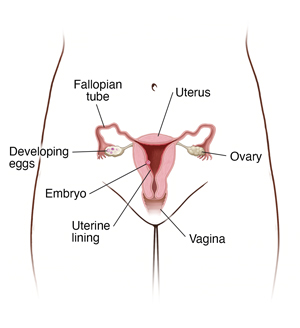
Front view of woman's pelvis showing cross section of uterus, ovaries, cervix, vagina, and fallopian tubes. Embryo is implanted in wall of uterus.


The man’s role in conception

Sperm are made in a man’s testicles. Fluid made by the prostate gland combines with sperm to form semen. During a man’s orgasm, semen flows to the urethra and out of the penis (ejaculation). If the semen was ejaculated in or near a woman’s vagina, sperm may travel into the uterus and the fallopian tubes. There, a sperm may join a mature egg to form an embryo. This results in pregnancy.
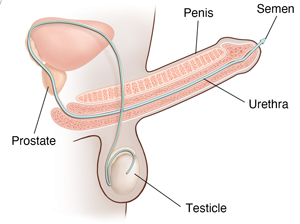
Side view of male reproductive anatomy with erect penis showing path of sperm.

Online Medical Reviewer: Donna Freeborn PhD CNM FNP

Online Medical Reviewer: Heather M Trevino BSN RNC

Online Medical Reviewer: Howard Goodman MD

Date Last Reviewed: 04/01/2025

© 2000-2026 The StayWell Company, LLC. All rights reserved. This information is not intended as a substitute for professional medical care. Always follow your healthcare professional's instructions.


Related Articles
Read article
OB/GYN
Understanding Vulvoplasty

During a vulvoplasty, the outer female genitals are created. This includes the clitoris and inner and outer labia. Learn more about this procedure and the recovery.

Read article
Heart Health
High Cholesterol (Hypercholesterolemia)

High cholesterol is called hypercholesterolemia. Cholesterol and dietary fat are not the same thing. It's important to understand how the fat in your diet affects your cholesterol levels.

Read article
Wellness
Walking for Fitness

Fitness walking has something for almost everyone, even people who are already fit. Walking is one of the safest ways to condition your body aerobically. It can boost energy, help you lose weight, and reduce stress.

Read article
Wellness
Low-Fat Diet

A low-fat diet will help you lose weight. It also can lower cholesterol and prevent symptoms of gallbladder disease. Here's a list of foods to eat more of, as well as those to stay away from.
