Dismiss Modal

Definition

Anatomy of Female Pelvic Area

Choose a preferred language
  • Endometrium. The lining of the uterus.

  • Uterus. Also called the womb, the uterus is a hollow, pear-shaped organ located in a person's lower abdomen, between the bladder and the rectum.

  • Ovaries. Two female reproductive organs located in the pelvis.

  • Fallopian tubes. Carry eggs from the ovaries to the uterus.

  • Cervix. The lower, narrow part of the uterus (womb) located between the bladder and the rectum. It forms a canal that opens into the vagina, which leads to the outside of the body.

  • Vagina. The passageway through which fluid passes out of the body during menstrual periods. It's also called the "birth canal." The vagina connects the cervix (the opening of the womb, or uterus) and the vulva (the external genitalia).

  • Vulva. The external portion of the female genital organs.
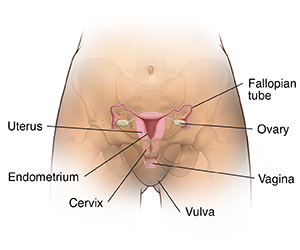
Front view of woman's pelvis with pelvic bones ghosted in, showing cross section of uterus, ovaries, and fallopian tubes.

Featured in

© 2000-2025 The StayWell Company, LLC. All rights reserved. This information is not intended as a substitute for professional medical care. Always follow your healthcare professional's instructions.
Related Articles
Read article
OB/GYN
Birth Control Methods

Birth control methods are used to help prevent pregnancy. There are many different methods to choose from.

Read article
OB/GYN
Understanding Uterine Bleeding

Your uterine bleeding may be heavy. Or you may have bleeding between periods. These problems may be caused by hormonal imbalance. Or they can be caused by uterine growths, an intrauterine device (IUD), bleeding disorder, or pregnancy.

Read article
OB/GYN
Understanding PMS and Your Cycle

PMS is a real condition caused by changing levels of hormones during your monthly period. No one knows why some women have PMS and others don't.

Read article
OB/GYN
Understanding Changes in Your Cervix

Cells in the cervix are always changing. In some cases, these cells can change to become abnormal. This is called dysplasia. Dysplasia can turn into cancer. But with regular Pap tests, dysplasia can be caught and treated early.