Important
Call
Step 1. Collect your supplies
-
Find a clean, well-lit space near a sink and mirror. Collect your supplies:
-
Suction machine
-
Clean suction catheter
-
Small bowl of
solution as instructed by your health care provider -
Clean gloves
-
-
Wash your hands with soap and clean, running water, or clean your hands with a waterless gel-based alcohol cleanser.
Step 2. Prepare to suction
-
Turn on the suction machine to the setting that your care team gave you.
-
Put on clean, disposable, powder-free gloves.
-
Attach the suction catheter to the suction machine. Dip the catheter tip into the
solution to be sure the suction is working. -
Do the following only if your health care provider tells you to: Put a small amount of
solution into your trach tube. This will help loosen mucus.
Step 3. Insert the catheter
-
Take a few deep breaths to fill your lungs with oxygen.
-
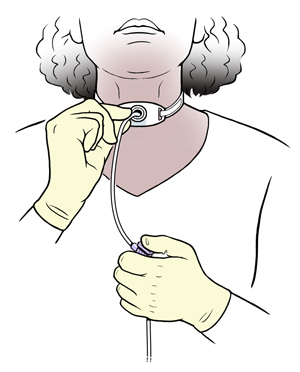
Gently insert the catheter into your trach tube. While you insert the catheter, don't suction. Stop inserting the catheter when you start to cough.
Step 4. Apply suction
-
Place your thumb over the suction port to create suction. At the same time, slowly pull the catheter out of your trach tube. Move the catheter tip in a circle as you pull the catheter out.
-
The catheter should be out of your trach tube within 5 to 10 seconds. If you need to suction more, relax and breathe for a few minutes before you start again.
-
When you have finished suctioning, turn off the suction machine. Throw away the used catheter, water, and gloves. Some catheters may be reused in certain situations. Follow your care team's specific instructions.
-
Wash your hands thoroughly.