Dismiss Modal

Management

Adult CF: The Respiratory System

Choose a preferred language

Cystic fibrosis (CF) is an inherited disease that causes problems in the body's cells that make salt, water, and mucus.

CF is caused by a change in the CFTR gene. CFTR stands for cystic fibrosis transmembrane conductance regulator. This change, or mutation, causes a problem in the CFTR protein that controls the flow of water and salt in and out of the body's cells. If you have CF, this protein doesn’t work right. So mucus and other secretions become thick and sticky.

Improved treatments can help people with CF live longer and healthier lives. Many people with CF live past age 30. Life expectancy is improving with continued development of new treatments.

Some people who have advanced CF may be considered for lung transplant. But this doesn't cure CF or stop it from harming other parts of the body.

You can also have problems in your upper respiratory tract. You can develop nasal polyps. These are small growths of tissue from the lining of the nose that extend into the nasal cavity. Sometimes, these polyps must be taken out by a health care provider. You may also have sinus infections.
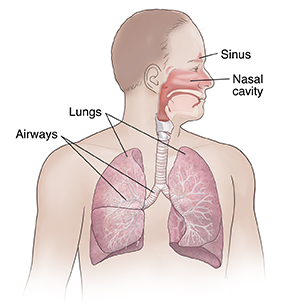
Outline of person's upper body showing respiratory system, including sinus, nasal cavity, lungs, and airways.

CF’s effects on the respiratory system also can cause these symptoms:

  • Chronic cough

  • Coughing up blood

  • Collapsed lung

  • A rounding and enlargement of the fingers and toes (clubbing)

  • Frequent lung infections with thick phlegm

  • Heart enlargement

  • Shortness of breath

  • Fever

  • Loss of appetite

  • Weight loss

  • Wheezing

  • Inflamed nasal sinuses (sinusitis)

© 2000-2025 The StayWell Company, LLC. All rights reserved. This information is not intended as a substitute for professional medical care. Always follow your healthcare professional's instructions.
Related Articles
Read article
Lung Health
Taking Bronchodilators

Bronchodilators are medicines that help open the airways of your lungs. These medicines are used to ease breathing problems caused by lung diseases like asthma.

Read article
Lung Health
Your Tracheostomy Tube: Tips for Eating and Drinking

When you first get your tracheostomy (trach), you may have some trouble eating and swallowing. Most patients are able to return to their usual eating habits after healing from the surgery is complete and swallowing has improved. Here are some things to keep in mind when eating with a trach tube.

Read article
Lung Health
Interstitial Lung Disease: Preventing Lung Infections

Interstitial lung disease is a group of conditions with inflammation and scarring around the tiny air sacs (alveoli) of the lungs. The changes make it hard to take in oxygen. Read on to learn how to prevent lung infections.

Read article
Lung Health
Exercising with Chronic Lung Disease: Increasing Strength

Try these helpful, step-by-step exercises for greater muscle strength.


