Your healthcare provider will diagnose COPD (chronic obstructive pulmonary disease) based on your past health history, a physical exam, and certain tests.
Health history
Your healthcare provider will ask you about your health history:
-
Current illnesses. Tell your provider about your symptoms and how long you've had them. Talk with your provider about other conditions you have. Tell them the medicines you use to treat them.
-
Past health and surgical history. Share other health problems and surgeries you've had.
-
Family history. Report health problems in family members, especially lung problems.
-
Social and environmental history. The most important factor in COPD is if you smoke or have smoked in the past. Also tell your provider if you've been around secondhand smoke, harmful chemicals, asbestos, or air pollution.
-
Daily activity. Report if breathing gets in the way of your daily activities.
Physical exam
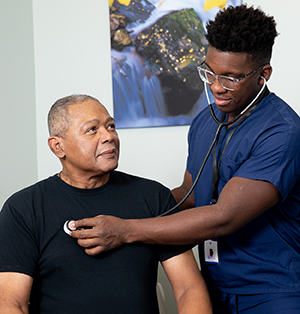
Your healthcare provider will examine you. They'll check your heart and lungs with a stethoscope. The focus will be on your airways. This will include your nose and throat.
Diagnostic tests
Your healthcare provider may recommend one or more of the following tests:
-
Pulmonary function tests. These measure airflow in and out of your lungs. They also check how much air your lungs can hold. The most common of these tests is spirometry. This measures how fast and how much air you can blow out (exhale). This test is important to help diagnose COPD. Sometimes you'll get an inhaled medicine. This is to see if your spirometry results improve.
-
Pulse oximetry. This test is done by placing a clip on your finger that shows how much oxygen is in your blood (oxygen saturation). This may be done at rest. It may also be done during and after exercise.
-
Arterial blood gas. This uses a needle to draw blood from an artery. It measures levels of oxygen and carbon dioxide in your blood.
-
Alpha-1 antitrypsin (AAT) testing. This is a blood test to look for AAT deficiency. AAT is a genetic condition that can affect your lungs.
-
Chest X-ray. This shows the size and shape of your lungs. It can also show certain problems in the lungs.
-
CT scan. This test uses a series of X-ray images taken from various angles around your body. These images are processed using a computer to create detailed cross-sectional images (slices) of the lungs.