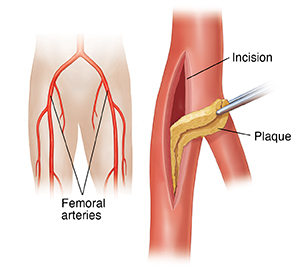
The femoral artery is a large blood vessel in the groin area. You have two femoral arteries, one on each side of the body. Each carries blood into one of the legs. Femoral endarterectomy is a procedure to clear a blockage from the femoral artery.
How to say it
ehn-dar-ter-EK-toh-mee
Why a femoral endarterectomy is done
Arteries throughout the body can become blocked by fatty deposits called plaque. Plaque in a femoral artery can slow the flow of blood to your legs. The result may be aching pain during walking. If blood flow is completely blocked, tissue can die. This can be very serious. Endarterectomy clears plaque from the artery so blood can flow freely again.
How a femoral endarterectomy is done
-
An IV (intravenous) line will be put into a vein in your arm or hand. This allows fluids and medicines to be given.
-
You will be given medicine so you don’t feel pain. You will likely get general anesthesia. This puts you into a state like deep sleep during the procedure.
-
The surgeon makes a cut (incision) in the skin over the site of the blocked artery. They expose the artery.
-
The surgeon puts clamps on the artery above and below the blockage. This temporarily stops blood flow. They then make an incision in the artery itself.
-
The surgeon removes plaque from the artery.
-
The surgeon closes the artery incision using stitches or a patch. They then remove the clamps from the artery.
-
The skin incision is closed. A tube or drain may be put into the incision to drain fluids from the area for a time after the surgery.
Risks of a femoral endarterectomy
Possible risks include:
-
Bleeding
-
Infection
-
Blood clots
-
Plaque coming back, needing another surgery
-
Unable to remove the plaque
-
More disease, needing a larger operation
-
Plaque breaking free and flowing to other parts of the leg, causing other blockages, tissue death, and loss of limb
Author: Michels, Karen
© 2000-2025 The StayWell Company, LLC. All rights reserved. This information is not intended as a substitute for professional medical care. Always follow your healthcare professional's instructions.