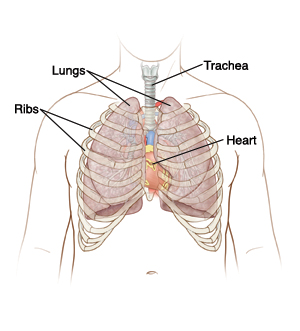
Chest pain can happen for a number of reasons. Sometimes the cause can't be found. If you've been checked by your health care provider and your condition does not seem serious, and if your pain does not appear to be coming from your heart, your provider may recommend closely watching for any symptoms. Sometimes the signs of a serious problem take more time to appear. Many problems not related to your heart can cause chest pain, such as:
-
Musculoskeletal problems. These include costochondritis (an inflammation of the tissues around the ribs that can occur from trauma or overuse injuries) and a strain of the chest wall muscles.
-
Respiratory problems. These include pneumonia, collapsed lung (pneumothorax), and inflammation of the lining of the chest and lungs (pleurisy).
-
Gastrointestinal problems. These include esophageal reflux, heartburn, ulcers, and gallbladder disease.
-
Anxiety and panic disorders.
-
Nerve compression and inflammation.
-
Rare problems, such as aortic aneurysm or aortic dissection (a swelling of the large artery coming out of the heart or a tear in the wall of the artery), and pulmonary embolism (a blood clot in the lungs).
Home care
After your visit, make sure to:
-
Rest today, and stay away from strenuous activity.
-
Take any prescribed medicine as directed.
-
Be aware of any chest pain that comes back, and notice any changes.
Follow-up care
Follow up with your health care provider if you don't start to feel better within 24 hours, or as advised.
Call 911
Call
-
A change in the type of pain. It may feel different, become more severe, last longer, or begin to spread into your shoulder, arm, neck, jaw, or back.
-
Shortness of breath or increased pain with breathing.
-
Weakness, dizziness, or fainting.
-
A rapid heartbeat.
-
A crushing feeling in your chest.
-
Coughing up more than a small amount of blood.
When to get medical advice
Call your health care provider or get medical care right away if you have:
-
A cough with dark colored sputum (phlegm) or small amount of blood.
-
A fever of 100.4ºF (38ºC) or higher, or as directed by your provider.
-
Swelling, pain, or redness in one leg.
Online Medical Reviewer: Heather M Trevino BSN RNC
Online Medical Reviewer: Rajadurai Samnishanth Researcher
Online Medical Reviewer: Rita Sather RN
Date Last Reviewed: 01/01/2025
© 2000-2026 The StayWell Company, LLC. All rights reserved. This information is not intended as a substitute for professional medical care. Always follow your healthcare professional's instructions.