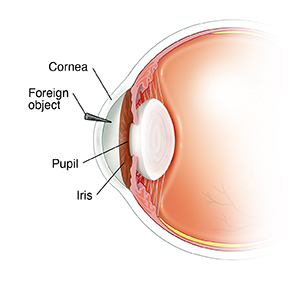
Your cornea is the clear layer on the front of your eyeball. It focuses light and helps protect your eye from dust and germs. A foreign object can get into the cornea itself. A trapped speck of dirt or grit is often a minor problem. But anything metal, or an object that goes through (pierces) your cornea, can cause severe damage. For instance, the cornea can be damaged from foreign bodies that get into the eye while using high speed machines (drills, saws), grinding metal, hammering, welding, or from explosions. The small pieces of metal travel toward the eye at high speed.
When to go to the emergency room (ER)
The longer you wait, the greater the chance of injury or infection. Get emergency medical help right away if:
-
There is an object in your eye that you can't flush out with water.
-
Your eye remains very swollen or painful after an object has been removed.
-
An object is embedded in your eye. Lightly cover both eyes with a sterile compress and call 911.
-
The front of your eye (cornea) is white or hazy.
-
You have blood in your eye (hyphema), in between the clear cornea and the colored iris.
-
You're having trouble seeing.
What to expect in the ER
-
A health care provider will ask about your injury and examine your eye.
-
You may be given eye drops to ease any mild pain.
-
The provider may use a microscope with a bright light (slit lamp) to help examine your eyeball. They may put a special dye (fluorescein) on the cornea to help see the object more clearly. This is also done to see if there are scratches (abrasions) on the cornea.
-
The provider may remove a loose foreign object. This may be done with a moistened cotton swab, irrigating your eye with water or saline, or sometimes with a small needle, scoop, or drill tool.
-
Severe injuries are likely to be treated by an eye specialist (ophthalmologist).
-
Antibiotic eye drops and possibly pain medicine will be prescribed if you are discharged home.
Follow-up
Contact your health care provider or get medical care right away if you have:
-
A fever of 100.4°F (38°C) or higher, or as advised by your provider.
-
Chills.
-
Increased redness or eye pain.
-
Drainage from your eye.
-
Blurred or decreased vision.
Online Medical Reviewer: Lalitha Kadali
Online Medical Reviewer: Rita Sather RN
Online Medical Reviewer: Ronald Karlin MD
Date Last Reviewed: 02/01/2025
© 2000-2026 The StayWell Company, LLC. All rights reserved. This information is not intended as a substitute for professional medical care. Always follow your healthcare professional's instructions.

