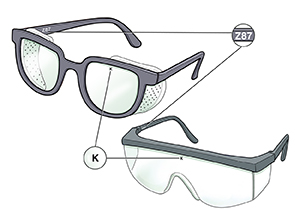
Safety glasses are protective eyewear that meets the requirements of the Occupational Safety and Health Administration (OSHA) and the American National Standards Institute (ANSI). OSHA enforces the occupational health and safety standards. ANSI gives manufacturing standards for protective eyewear. Advances in technology allow for safety glasses that are more comfortable and attractive than before. But they still meet current requirements.
How to recognize safety glasses
-
Frames. Safety frames are stronger than street wear frames and are heat-resistant. They help prevent lenses from being pushed into your eyes.
-
Lenses. Safety glasses that meet ANSI standards have glass or polycarbonate lenses. They are stronger than street wear lenses. They are also more impact-resistant. They come in prescription and nonprescription (plano) forms.
How to clean and maintain eye protection
Like any other piece of equipment, safety glasses need to be maintained. Learn how to clean and store, and when to replace, your safety glasses.
-
Cleaning. Look at your safety glasses every day. Follow the manufacturer's instructions for cleaning. Rough handling when cleaning can scratch the lens. It can also make the lens weaker.
-
Storing. Store your safety glasses in a clean, dry place where they can't fall or be stepped on.
-
Replacing. Scratched, broken, bent, or ill-fitting eyewear should be replaced as soon as possible. Damaged eyewear interferes with your ability to see. The protective features may also be reduced