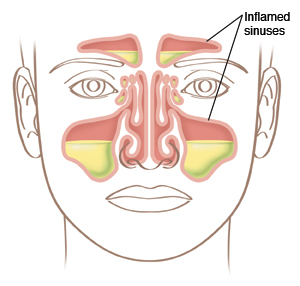
Sinusitis is swelling (inflammation) of the tissue that lines the sinuses. The sinuses are air-filled spaces in the bones of the face. They connect to the inside of the nose. Sinusitis can occur during a cold. It can also be due to allergies to pollens and other particles in the air. It can cause symptoms, such as sinus congestion, headache, sore throat, face swelling, and a feeling of fullness. It may also cause a low-grade fever. Your doctor has determined that your sinusitis is not caused by bacteria. No antibiotics are needed.
Home care
-
Drink plenty of water, hot tea, and other liquids, as directed by your doctor. This may help thin nasal mucus. It also may help your sinuses drain fluids.
-
Heat may help soothe painful parts of your face. Use a towel soaked in hot water. Or stand in the shower and direct the warm spray on your face. Using a vaporizer along with a menthol rub at night may also help soothe symptoms.
-
Try a steroid nasal spray. It may help with your symptoms.
-
Try a decongestant nasal spray, such as oxymetazoline or phenylephrine. Don't use it for more than 3 days in a row. Using it for more than 3 days can make your congestion worse.
-
If advised by your doctor, over-the-counter antihistamines may help if allergies are the cause of your sinusitis.
-
If needed, take an over-the-counter pain medicine, such as acetaminophen, ibuprofen, or naproxen. Read and follow all instructions on the label.
-
Use nasal rinses or irrigation with saltwater, as directed by your doctor.
-
Don't smoke. This can make symptoms worse.
Follow-up care
Follow up with your doctor if you are not better in 1 week.
When to get medical care
Contact your doctor if you have:
-
Green or yellow fluid draining from your nose or into your throat.
-
Facial pain or a headache that gets worse.
-
A stiff neck.
-
Swelling of your forehead or eyelids.
-
Vision problems, such as blurred or double vision.
-
A fever of
100.4 ºF (38 ºC) or higher, or as advised by your doctor. -
Symptoms that don't go away in 10 days or get worse after starting to get better.
Call 911
Call
-
You have a seizure.
-
You have trouble breathing.
-
You have confusion or abnormal drowsiness.
-
You feel dizzy or faint.
-
Your fingernails, skin, or lips look blue, purple, or gray.
Online Medical Reviewer: Jessica Gotwals RN BSN MPH
Online Medical Reviewer: Rita Sather RN
Online Medical Reviewer: Sumana Jothi MD
Date Last Reviewed: 06/01/2025
© 2000-2026 The StayWell Company, LLC. All rights reserved. This information is not intended as a substitute for professional medical care. Always follow your healthcare professional's instructions.

