After a colostomy, stool is most often collected in a pouch that attaches to your body around the stoma. An adhesive skin barrier holds the pouch in place and keeps stool from leaking onto the skin. Most pouches are made of lightweight, odor-proof plastic. They lie flat against the body so they don’t show or make noise.
Types of pouches
There are many styles of pouches. Your healthcare provider or ostomy nurse will help you select the one that’s best for you. The skin barrier has to fit around the stoma without touching it. And it must stick well so there is no leaking or odor from the pouch.
Two-piece drainable
-
The skin barrier and the pouch are separate pieces. The skin barrier is applied to the skin. The pouch snaps onto a flange on the skin barrier.
-
The bottom of the pouch has a tail with an opening. The tail is folded over and held closed with Velcro closures or a clamp.
-
To empty the pouch, you open the Velcro closures or remove the clamp.
One-piece drainable
-
The skin barrier and the pouch come as 1 piece. The skin barrier holds the pouch onto the skin.
-
The bottom of the pouch has a tail with an opening. The tail is folded over and held closed with Velcro closures or a clamp.
-
To empty the pouch, you remove the Velcro closures or the clamp.
One-piece closed-end
-
The skin barrier and the pouch come as 1 piece. The skin barrier holds the pouch onto the skin.
-
The bottom of the pouch is sealed, so it can't be opened and emptied.
-
You remove the pouch and dispose of it when it is about one-third full.
Sizing the stoma opening
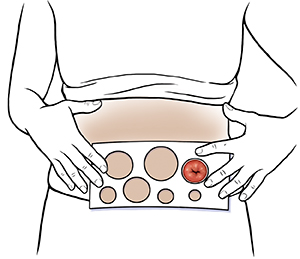
For the pouch to fit around the stoma, the skin barrier must have an opening. Some skin barriers have precut openings, and some you size and cut yourself. To find the correct size opening for your stoma, use a measuring guide. Most pouches come with a guide in the box. Your healthcare provider may also give you one:
-
Find the smallest hole on the guide that fits around the stoma without touching it. There should be about one-eighth inch between the stoma and the hole on the guide.
-
To cut the opening yourself, center the guide hole on the back of the skin barrier. Trace the pattern. Then cut the opening using curved scissors.
-
For precut openings, order pouches with the size opening that matches the size of the hole on the guide.
Pouch accessories
You can buy other stoma care products through special catalogs, at medical supply stores, and at some drugstores:
-
Powders and wipes add an extra layer of skin barrier. This helps protect the skin if stool leaks.
-
Adhesive paste and skin barrier wafers fill in uneven places in the skin around the stoma. This helps the pouch stick better.
-
Convex skin barriers help make a better seal when the skin around the stoma is uneven or the stoma is level with or sinks below the skin. Some convex barriers come with a pouch attached. Others are inserts that can be added to any pouch.
-
Pouch filters and deodorants help prevent odor.
-
Ostomy belts help keep the pouch in place.
-
Pouch covers help keep the skin under the pouch dry and comfortable.
-
Self-adhesive plastic caps can be used instead of a pouch if you irrigate or have regular bowel movements.
Online Medical Reviewer: Jen Lehrer MD
Online Medical Reviewer: Raymond Kent Turley BSN MSN RN
Online Medical Reviewer: Rita Sather RN
Date Last Reviewed: 08/01/2024
© 2000-2026 The StayWell Company, LLC. All rights reserved. This information is not intended as a substitute for professional medical care. Always follow your healthcare professional's instructions.