Dismiss Modal

Causes

How a Hernia Develops

Choose a preferred language

A hernia bulge may appear suddenly, but hernias often take months or years to develop. They grow larger as pressure inside the body presses the intestines or other tissues out through a weak area in the belly (abdominal) wall. This is often at the belly button or a site of a past surgery. With time, these tissues can bulge out beneath the skin.


Stages of hernia development

The wall weakens or tears: The abdominal lining bulges out through a weak area and begins to form a hernia sac. The sac may contain fat, intestine, or other tissues. At this point, the hernia may not cause a visible bulge.
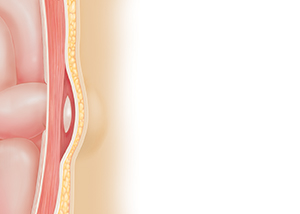
Cross section of body wall showing hernia. Intestine slightly protruding through defect in muscle underneath skin.

The intestine pushes into the sac: As the intestine pushes farther into the sac, it forms a visible bulge. The bulge may flatten when you lie down or push against it. This is called a reducible hernia. It does not cause any immediate danger.
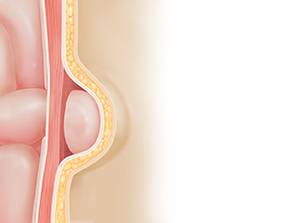
Cross section of body wall showing hernia. Intestine protruding through defect in muscle underneath skin.

The intestine may become trapped: The sac containing the intestine may become trapped by muscle (incarcerated). If this happens, you won’t be able to flatten the bulge. You may also have pain. You may need prompt treatment.
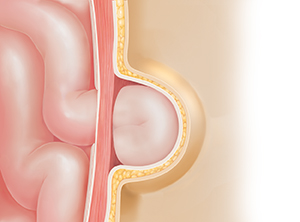
Cross section of body wall showing hernia. Intestine protruding through defect in muscle underneath skin.

The intestine may become strangulated: If the intestine is tightly trapped, it becomes strangulated. The strangulated area loses blood supply and may die. This can cause severe pain and block the intestine. You need emergency surgery.
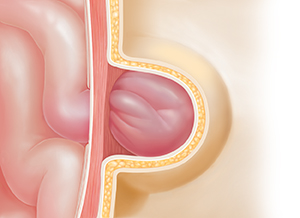
Cross section of body wall showing hernia. Intestine protruding through and trapped in defect in muscle underneath skin.

© 2000-2026 The StayWell Company, LLC. All rights reserved. This information is not intended as a substitute for professional medical care. Always follow your healthcare professional's instructions.


Related Articles
Read article
Digestive Health
Intestinal Obstruction

If your healthcare provider determines that you have an intestinal obstruction, it means that something is blocking your intestine. Food and stool may not be able to move freely. Read on to learn more about this condition, including symptoms, diagnosis, and treatment.

Read article
Digestive Health
What Is Irritable Bowel Syndrome (IBS)?

People who have irritable bowel syndrome (IBS) have digestive tracts that react abnormally to certain substances or to stress. This leads to symptoms like cramps, gas, bloating, pain, constipation, and diarrhea.

Read article
Digestive Health
Understanding Functional Dyspepsia

Functional dyspepsia is a set of long-term symptoms. You can learn ways to manage your symptoms over time. This may include taking medicines. It may also mean making changes to your diet and managing your mental health.

Read article
Digestive Health
Stoma Care: Emptying the Pouch

Here are images that show the steps for emptying the pouch for your stoma.