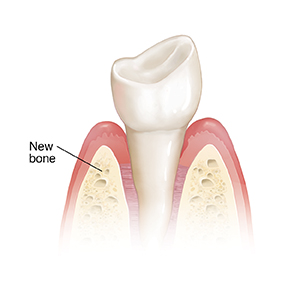
Teeth are held in place by gums, bone, and other tissues. But periodontal disease can cause the bone to break down. Methods called regenerative procedures can be used to stimulate growth of new bone. This growth increases the height of the bone around the tooth. This gives the tooth more support. It increases the amount of attachment around the root of the tooth. Restoring even half of the amount of lost bone extends the life of the tooth. One type of regenerative procedure is called guided tissue regeneration (GTR).
How GTR works
GTR is a method used to repair periodontal defects so that a tooth, or set of teeth, has more support and stability. Periodontal disease (periodontitis) is a process where bacteria trapped under the gums leads to a chronic infection. This causes the hard and soft tissues that support the teeth to break down. In certain cases, this leads to gaps that form between the teeth and bone. These gaps, or bony defects, often need to be treated with a separate procedure known as a bone graft. This is where material is placed into the defect to promote new bone growth.
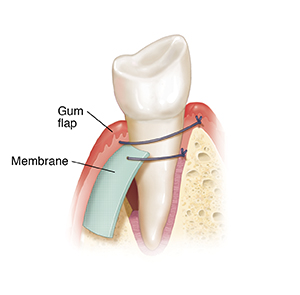
GTR uses a resorbable or nonresorbable artificial membrane. These keep soft tissue from growing into the gaps. The membrane blocks the fast-growing soft tissue cells from growing into the site. This lets the slower-growing bone-making cells to grow there instead. This is how GTR is done:
-
Surgery on gum and bone. The gum is opened with a procedure known as a flap. The area under the gums is cleaned out to remove all bacteria. Then a membrane is placed over the damaged bone.
-
Separating tissues. Once in place between bone and gum, the membrane provides space and time for the bone to heal and start building itself.
-
Care during healing. You need to keep up a good daily oral hygiene routine. And you need to keep your regular dental care visits. Follow all directions from your dental care provider. This will make sure that your gums stay healthy and periodontitis doesn’t happen again.
-
After healing. The stitches and membrane dissolve or are removed. In about 6 months, new attachments and bone have grown to support the tooth or teeth.