Dismiss Modal

Types

Types of Brain Aneurysms

Choose a preferred language

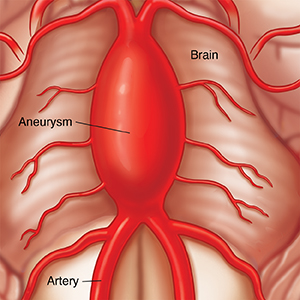
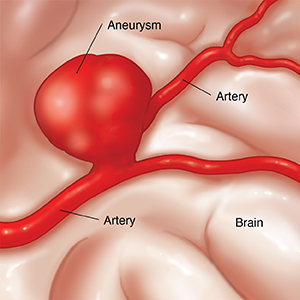
There are several types of brain aneurysms that are classified by shape. These are saccular (also called berry) aneurysms, which are by far the most common. Less common are the fusiform and dissecting types. Brain aneurysms may also be classified by:

  • Size (small, large, and giant)

  • Location

  • Cause (such as a mycotic aneurysm, caused by an infection)

Most aneurysms occur where an artery branches, often at the base of the brain. The risk of an aneurysm bursting (rupturing) can be affected by the shape and location of the aneurysm. The treatment options vary, depending on the type of aneurysm, its size, and its location.
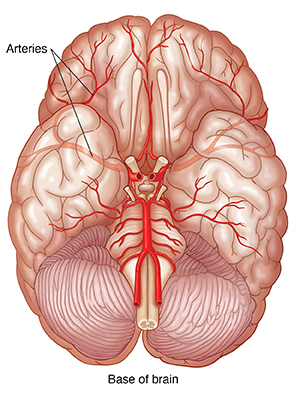
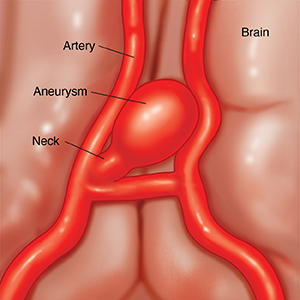
Brain viewed from bottom showing brain stem, cerebellum, and arteries.

Closeup of brain showing artery with saccular aneurysm.

Closeup of brain showing artery with fusiform aneurysm.

Closeup of brain showing giant aneurysm involving two arteries.

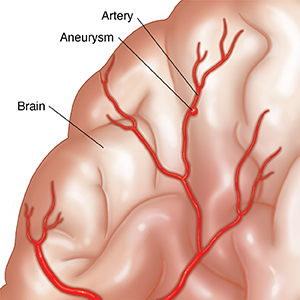
Closeup of brain showing mycotic aneurysm on artery.

© 2000-2025 The StayWell Company, LLC. All rights reserved. This information is not intended as a substitute for professional medical care. Always follow your healthcare professional's instructions.

Related Articles
Read article
Brain Health
Trigeminal Neuralgia

Trigeminal neuralgia is pain caused by irritation of the trigeminal nerve in your face. Symptoms include sudden, sharp pain in your head or face. Read on for tips on how to care for yourself at home.

Read article
Brain Health
Understanding Corticobasal Degeneration (CBD)

CBD causes some parts of the brain to shrink and lose nerve cells. This happens over time in the outer layer of the brain (cortex).

Read article
Brain Health
Head Trauma (Traumatic Brain Injury)

Head trauma can be fatal. The effects from some types of head trauma may not appear right away. So it’s important to get medical attention for any severe head injury.

Read article
Brain Health
Understanding Vasovagal Syncope

Vasovagal syncope is fainting caused by a complex nerve and blood vessel reaction in the body. It's the most common cause of fainting. Unlike other causes of fainting, it's not a sign of a problem with the heart or brain.