Dismiss Modal

Treatment

Spinal Fusion: Anterior Lumbar

Choose a preferred language

Spinal fusion surgery is performed to connect two or more bones in the spine so that they heal into a single, solid bone. These bones are called vertebrae. Fusing vertebrae in the lower (lumbar) spine may help ease lower back and leg pain.

A lumbar fusion is an effective and popular surgical procedure to restore the intervertebral disc space and stabilize the spine. Anterior lumbar interbody fusion (ALIF) is done through an incision in your abdomen. The surgery may take from 3 to 8 hours. This depends on how many vertebrae are fused. In some people, an ALIF is combined with a posterior instrumented fusion (PIF). This is done through an incision in the back.
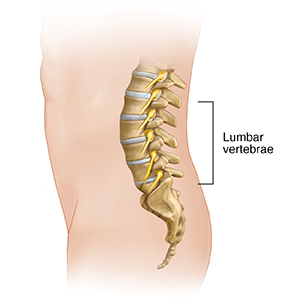
Side view of lower back showing lumbar spine.


The fusion procedure

Here is what to expect:

  • An incision is made on one side of your abdomen.

  • The disk is removed from between the vertebrae that require fusion. This leaves an empty space between the vertebrae.

  • A bone, synthetic, or metal graft is placed into the empty space.

  • The graft may be held in place with screws or a plate with screws. Over time, the graft and the bone around it grow into one solid unit.

  • A tube called a drain may be left in the wound for a few days.

  • The incision is closed with sutures or staples.
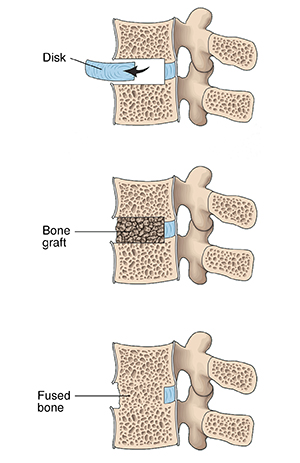
Cross section of lumbar vertebrae showing three steps in lumbar fusion.

© 2000-2025 The StayWell Company, LLC. All rights reserved. This information is not intended as a substitute for professional medical care. Always follow your healthcare professional's instructions.
Related Articles
Read article
Brain Health
Treating Seizures: Medicines

If you had a seizure, your health care provider will create a treatment plan for you. You may be prescribed medicines.

Read article
Brain Health
Treating Complex Regional Pain Syndrome (CRPS)

Treatment for complex regional pain syndrome (CRPS) starts with therapy that teaches you ways to move the affected body part. But if your pain prevents this therapy, you may have other treatment first. The sooner you get treatment, the more likely you are to get better.

Read article
Brain Health
Treating an Arteriovenous Malformation (AVM)

It's important to get medical attention for an AVM as soon as possible. Often, immediate treatment may help prevent serious complications of some AVMs. Current surgical methods make treatment for AVM safer and more effective than ever. The goal of treatment is to stop the flow of blood within the AVM and to prevent it from re-bleeding.

Read article
Brain Health
Head Injury With Sleep Monitoring (Adult)

Even if a head injury seems mild, symptoms of a more serious problem may appear later. You and someone caring for you will need to watch for symptoms.


